Examination & Study Resources
Detailed information about AGSI certification examinations, preparation resources, and examination integrity safeguards.
Overview of the Certification Examination
AGSI certification is earned by passing a timed, proctored examination designed to assess applied professional judgment rather than rote memorization.
Required for both levels
For each examination level
Multiple-choice format
Delivery & Integrity
Examinations are delivered asynchronously via secure link. AGSI employs identity verification, screen-locking, and behavioral monitoring to ensure integrity. Violations may result in disciplinary action.
Open Book Policy
Reference materials (including the Competence Framework) are permitted. However, exams are scenario-based and time-constrained. Success depends on comprehension, not lookup speed.
Examination Content Areas
While candidates are informed of content weighting, question selection and order are randomized to protect validity.
Level I — CGCT
Certified Grill Cleaning Technician- Professional Responsibility & Ethics 15-20%
- Mechanical Architecture 20-25%
- Combustion Fundamentals 20-25%
- Scientific Maintenance Principles 20-25%
- Documentation & Risk Disclosure 10-15%
Level II — CAGST
Advanced Grill Service Technician- Professional Judgment (Adv.) 10-15%
- System Interdependency 15-20%
- Combustion Kinetics & Failure 25-30%
- Forensic Diagnostics 25-30%
- Adv. Documentation & Contexts 10-15%
Study Resources
Prepare effectively with official AGSI materials.
Competence Framework
Defines the complete scope of knowledge and professional judgment assessed by AGSI examinations. All exam content is derived solely from this framework.
- Full Body of Knowledge (BoK)
- Transparency & Fairness
- Absolutely Essential for Prep
Optional Study Guide
Designed to help candidates organize independent study and contextualize the standards.
- Interprets abstract principles
- Applied scenarios
- Efficient preparation structure
Sample Questions
These questions are not from the live bank. They are provided solely to illustrate the style, depth, and reasoning expected.
Q1. Professional Competence
A technician observes persistent yellow flame tips and light soot accumulation but dismisses them because the grill still ignites and heats. Which conclusion best aligns with AGSI’s definition of professional competence?
Correct Answer: CQ2. Scope of Practice
While servicing a residential grill, a technician notices an undersized gas line supplying the appliance. The technician is not licensed to perform gas piping installation. Which response is appropriate?
Correct Answer: CQ3. Combustion Fundamentals
A grill exhibits a stable ignition but develops yellow-tipped flames and soot buildup that cannot be corrected by adjusting the air shutter. This condition most directly indicates:
Correct Answer: CQ1. Systemic Interdependency
A grill experiences repeated ignition wire failures despite replacement. Inspection reveals a degraded heat shield with increased surface oxidation. Which mechanism best explains the repeated failures?
Correct Answer: CQ2. Dynamic Pressure Collapse
During diagnostics, a technician measures a dynamic manifold pressure drop exceeding 20% when all burners are operating. This condition most strongly indicates:
Correct Answer: CQ3. Forensic Combustion Analysis
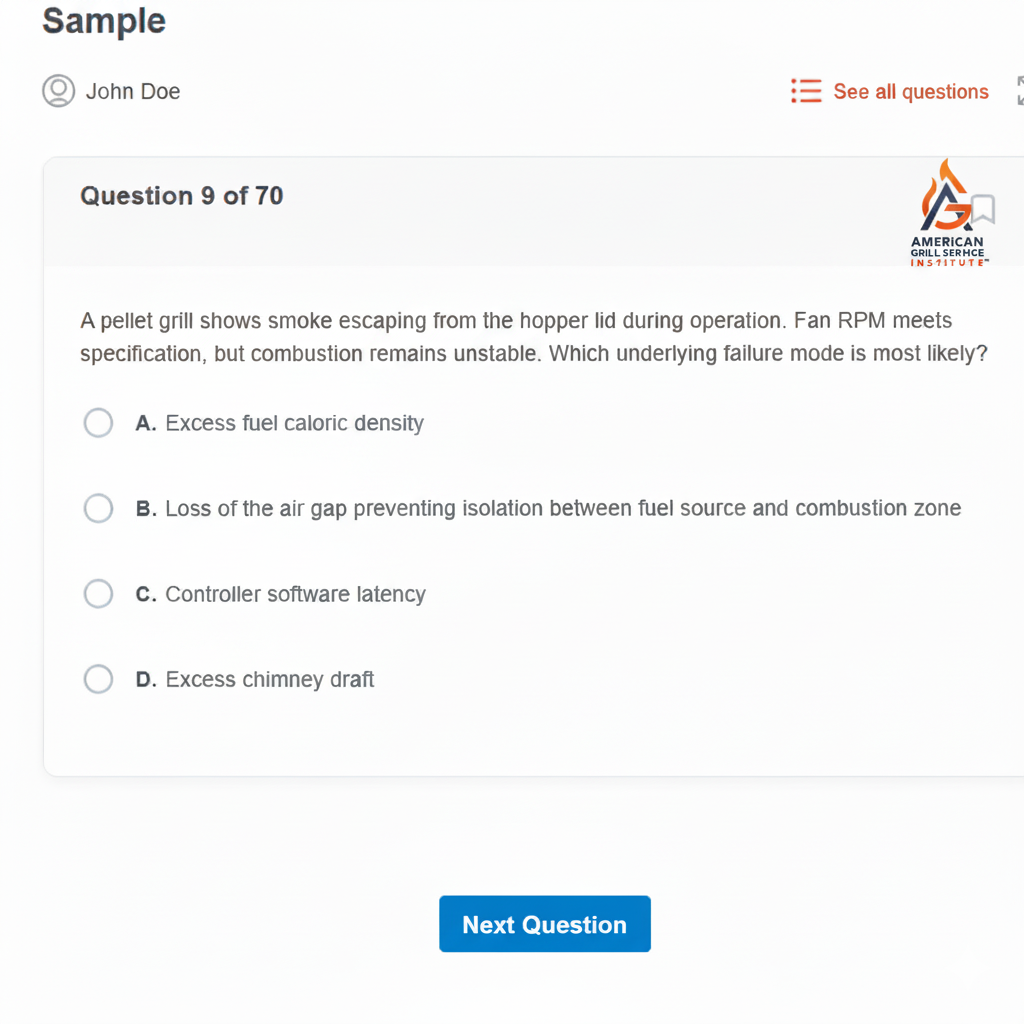
A pellet grill shows smoke escaping from the hopper lid during operation. Fan RPM meets specification, but combustion remains unstable. Which underlying failure mode is most likely?
Correct Answer: BExam
Online
Available 24/7
Timed (90 Minutes)
70 Questions
All Multiple Choice (A-D)